




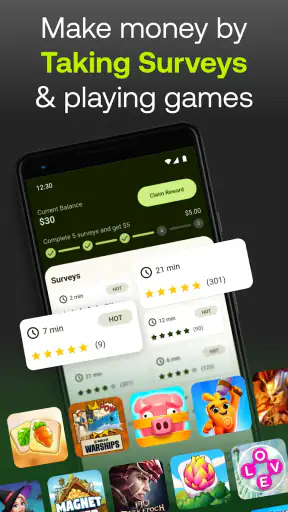

I tried Five Surveys as a simple way to turn spare minutes into small cash rewards, and its appeal is easy to understand: the app focuses on paid surveys rather than asking you to learn a complicated rewards system first. That narrow purpose is also its biggest strength. If you already have a few quiet moments during the day and do not mind answering questions about yourself, it gives those moments a clear use.
My experience was more practical than exciting. This is not an income replacement, and I would not treat it like one. It is better viewed as a small-reward lifestyle app for people who are comfortable exchanging attention for occasional payouts. The important question is not whether surveys can make you rich; they cannot. The useful question is whether this particular survey workflow feels convenient enough to fit naturally into your routine.
Five Survey AB developed the app, which is free to install and sits in the Lifestyle category. It is rated for mature users aged 17 and over. The app has reached more than a million installs, with an average rating of 4.2 from roughly 242 thousand ratings and about 25 thousand written reviews. Those figures suggest that the idea has found a sizable audience, although popularity alone does not guarantee that every survey will suit every person.
Why the paid-survey focus matters
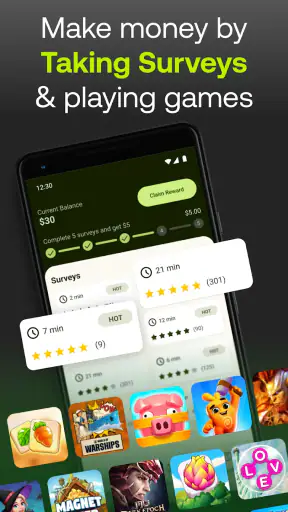
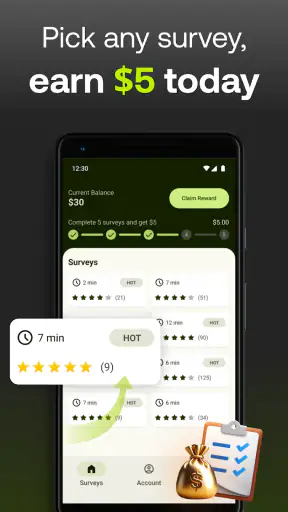
The central capability is straightforward: Five Surveys presents opportunities to answer surveys in exchange for money rewards. That sounds similar to many reward apps, but the focused design changes how I approached it. Instead of browsing a large catalog of unrelated tasks, I opened it with one expectation: check whether a survey is worth my time, complete it if it is, and leave when there was nothing suitable.
The real benefit is convenience, not earning power. A survey can occupy a short gap that would otherwise disappear while waiting for transport, sitting in a reception area, or taking a break from routine work. I found the app most useful when I treated it as an optional activity rather than a daily obligation. That mindset prevents the reward from becoming disappointing when the available opportunities are limited.
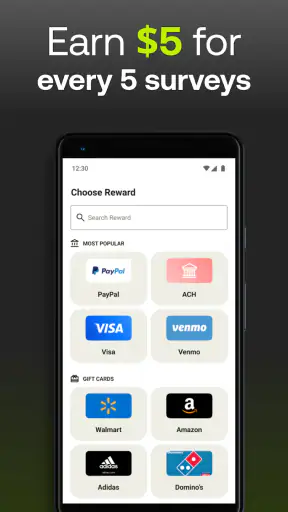
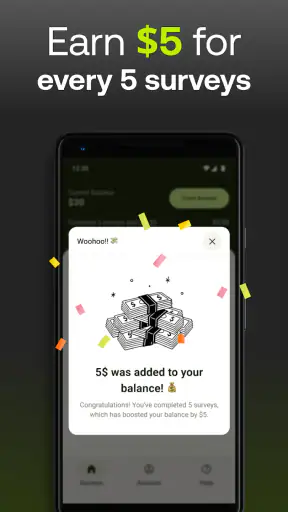
The store summary emphasizes quick paid surveys, cash rewards, and instant payouts for opinions. In practice, that positioning tells you what the app is trying to do well: reduce the distance between giving an opinion and receiving a reward. It is not designed to replace a budgeting app, a freelance marketplace, or a traditional part-time job. Comparing it with those alternatives would be unfair because the time commitment and earning expectations are completely different.
What makes the capability useful is the low barrier to entry. You do not need a special skill, portfolio, or product to sell. Your value comes from matching the audience a survey is looking for. That also creates the main uncertainty: an available survey may not always be a good match, and answering honestly does not guarantee that every questionnaire will lead to a completed reward.
What using it actually feels like
I recommend beginning with a time limit. Before opening a survey, I would decide whether I have five or ten spare minutes and avoid starting anything that could interfere with a more important task. This small habit matters because survey apps can feel efficient at first, then become frustrating if a questionnaire takes longer than expected or turns out not to fit its intended audience.
The most sensible workflow is to check the app when you already have idle time, read the basic opportunity details carefully, and answer consistently. Rushing through questions just to reach the end is a poor trade. It can make the experience less pleasant and may lead to answers that do not reflect your real opinions. Since the entire point is to provide useful feedback, I found that a calm, honest approach was more appropriate than trying to game the process.
Another practical tip is to think of each survey as a separate decision. Do not assume that opening one means you must finish it. If the subject is irrelevant to you, the questions become repetitive, or the time feels disproportionate to the reward, closing the survey can be the better choice. The app is most useful when it gives you flexibility, not when it pressures you into completing every available task.
The current version is 1.1.65, and the app supports devices running Android 7.0 or later. That makes it accessible to people using older Android phones, although the quality of the experience will still depend on the phone, connection, and how comfortably you can read and type on its screen. I would use a stable connection when possible, especially if I were answering a longer questionnaire and did not want an interruption to waste the time already spent.
A realistic everyday use case
Imagine finishing an appointment earlier than expected and having a quiet stretch before your next commitment. I would open Five Surveys, look for a survey that appears manageable within that gap, and complete it without expecting more than a modest reward. The app works well in this situation because the activity has a clear beginning and end. When the appointment is over, I can put the phone away without leaving a larger task unfinished.
A similar routine can work during a commute, provided you are not driving and the environment allows you to concentrate. I would avoid starting a survey if I might need to stop repeatedly, because interrupted answers are more annoying than useful. The best moments are predictable pockets of downtime: a lunch break, a waiting room, or the few minutes before an event begins.
There is also a useful household scenario. Someone who already spends time giving opinions about products, services, or habits may prefer to put that interest toward a reward instead of answering informal polls elsewhere. Five Surveys gives that activity a dedicated place. It does not make the opinions more valuable by itself, but it can make the process feel more purposeful.
For students and people with irregular schedules, the app may fit better than a fixed side job because it does not require a shift. However, that flexibility comes with less predictability. A scheduled job tells you when you work and what you will earn for that time. A survey app asks you to check for suitable opportunities and accept that the available choice may vary.
The tradeoff between speed and consistency
The promise of fast surveys is attractive, but speed should not be confused with guaranteed availability. The app can be quick when a suitable questionnaire is ready and your profile matches its audience. At other times, checking the app may not produce a worthwhile task. That variability is the first tradeoff I would explain to a friend before recommending it.
The second tradeoff is attention. Survey questions may be easy to understand, but they still require concentration and honest answers. If you are tired, distracted, or trying to complete one while doing something else, the reward may not justify the irritation. I would rather complete one survey carefully than rush through several while barely reading them.
There is also a psychological tradeoff. Seeing a cash reward attached to a short task can make small amounts feel more significant than they are. I found it helpful to judge the app by the total value of the time, not by the excitement of each individual payout. If you would not normally spend those spare minutes on anything useful, the app can be a pleasant bonus. If you need dependable income, it is the wrong tool.
Compared with cashback services, Five Surveys is more direct because the activity is giving opinions rather than shopping. That can be an advantage for someone who does not want to change purchasing habits. Compared with microtask platforms, it may feel simpler because surveys are a familiar format, but it does not offer the same variety of work. And compared with a paid research panel that asks for longer participation, the shorter format may be easier to fit into ordinary life, while potentially offering less depth per task.
These comparisons reveal an important limitation: the best alternative depends on what you already do. If you shop online frequently, cashback may require less active attention. If you have a specific skill, freelance work can offer a better return on time. If you enjoy answering questions and want a low-commitment option, this app is more relevant. I would not install it merely because it is free; I would install it because the survey format suits my habits.
How to make the experience less frustrating
My first recommendation is to protect your expectations. Think of the rewards as incidental spending money rather than a target you must hit. That makes it easier to skip unsuitable surveys and avoids turning a casual activity into a source of pressure.
Second, answer profile questions carefully and keep your information consistent. Survey matching depends on knowing what kind of participant you are, so careless answers can make later opportunities less relevant. I would also avoid changing answers simply because I think a particular response might lead to a reward. Honest consistency is more sensible than guessing what the survey creator wants to hear.
Third, use a simple personal log if you are unsure whether the app is worthwhile for you. Note the approximate time spent and the rewards received over several sessions. You do not need a complicated spreadsheet. A few notes are enough to reveal whether Five Surveys fits your schedule or whether another option gives you better value. This is one of the most useful ways to judge a rewards app because the headline promise does not tell you how it performs for your particular profile.
Finally, stop treating every notification or available task as urgent. A survey is only useful when it fits the moment. Checking repeatedly can create more distraction than reward. I would choose one or two natural times to look at the app, then close it and continue with the day.
Who will benefit most
Five Surveys is a good match for adults who enjoy sharing opinions, have irregular pockets of free time, and are happy with small cash rewards. It suits people who want a low-commitment activity that can be started and stopped without arranging a shift. It may also appeal to users who prefer answering questions over shopping-based rewards or skill-based gig work.
The app is less suitable for anyone who needs predictable earnings, dislikes questionnaires, or becomes frustrated when opportunities do not match their interests. I would also skip it if my phone time is already crowded with more valuable tasks. Free installation does not make an app free in the broader sense; your attention still has a cost.
The mature age rating is worth taking seriously when deciding whether to recommend it within a household. It is intended for users aged 17 and above, so I would not present it as a general-purpose activity for younger children. For an eligible adult, the rating is one more reason to use ordinary judgment when deciding what personal opinions to share and how much time to spend.
Five Surveys also makes more sense for someone who can accept uneven results. A person with a narrowly defined background may see fewer relevant opportunities than someone whose experiences align with a wider range of research topics. That is not necessarily a defect in the app; it is a consequence of how opinion-based matching works. Still, it means two users can have noticeably different impressions.
My final view after using the app
I like Five Surveys because it stays focused. The app does not need to become an all-purpose rewards center to be useful. Its strongest role is helping me turn otherwise empty minutes into a small, clearly defined task. The cash-reward angle gives the activity a reason to exist, while the survey format keeps the entry barrier low.
At the same time, I would not recommend it with the promise of fast or reliable income. The value depends on available surveys, personal suitability, patience, and the amount of attention each task demands. For me, the right approach is selective: check it during genuine downtime, choose carefully, answer honestly, and leave when the exchange no longer feels worthwhile.
With its free price, broad Android compatibility, and established audience, Five Surveys is easy to try if paid questionnaires already sound appealing. My recommendation is positive but limited: use it as a small lifestyle extra, not as a financial plan. If that is the role you want, the app’s focused capability can make ordinary waiting time feel a little more productive.


